
Selling woodworking machinery requires a fundamentally different approach than selling general industrial equipment. This article specifically addresses woodworking and joinery companies that wish to sell, modernise or phase out their machinery fleet. The insights provided here are not intended for metalworking equipment, construction machinery or other production categories.
Why woodworking machinery forms a distinct category
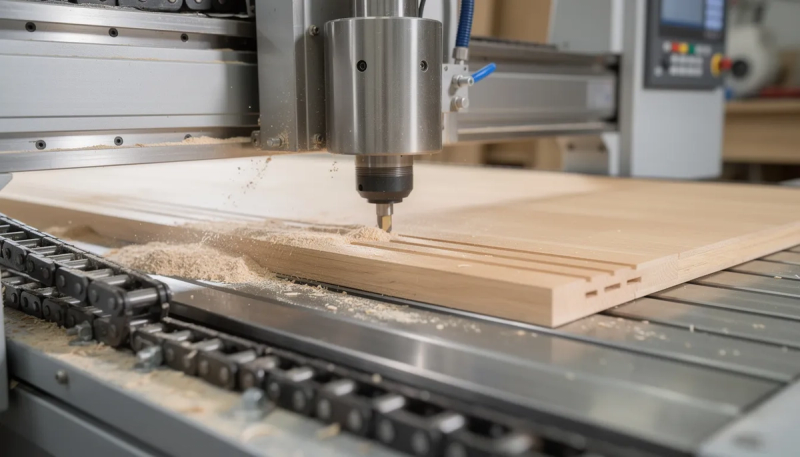
Woodworking machinery differs significantly from metalworking or general production equipment. This stems from the unique physical properties of wood: varying density, grain direction, moisture content and sensitivity to splintering or warping. These characteristics require precise adjustments in tooling, feed mechanisms and control systems.
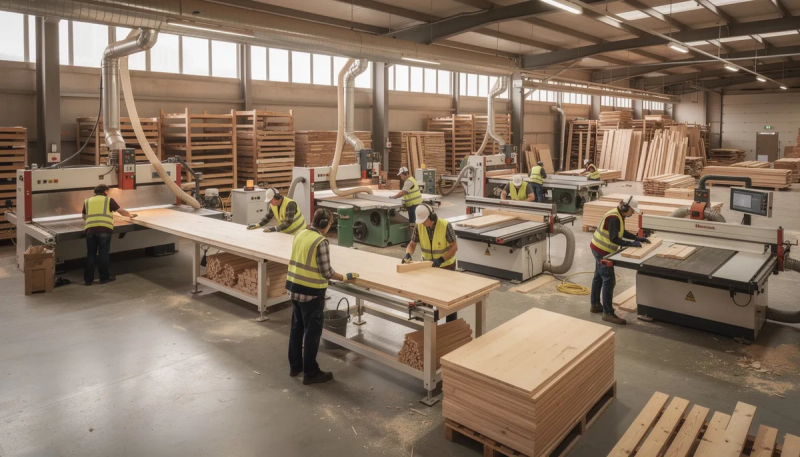
Typical machines in joinery and interior construction
| Machine type | Application |
|---|---|
| CNC machining centre / CNC router | Panel processing, 3D shaping, nesting |
| Thickness planer | Planing wood to consistent thickness |
| Surface planer | Flattening and preparing solid timber |
| Panel saw / sliding table saw | Straight panel cutting |
| Beam saw | High-volume panel cutting |
| Edge banding machine | Application of ABS, PVC or veneer edging |
| Wide belt sander | Surface finishing and calibration |
| Wood press / veneer press | Veneering and lamination |
| Profiling machines | Window, door and moulding production |
| Drilling and dowel machines | Structural joinery connections |
Machines are often highly customised. A CNC router configured for kitchen production differs fundamentally from one set up for windows or staircases. An edge bander optimised for 0.8–2 mm ABS edging serves a different buyer profile than one for solid wood veneer.
Key technical parameters influencing value and buyer suitability include:
- Tolerances and precision levels
- Dust extraction integration
- Glue systems (EVA vs PUR)
- Software versions (BiesseWorks, WoodWOP, Alphacam)
- Integration with extraction systems
- CE marking and safety features
CE certification, emergency stops, guarded covers and light barriers play an especially important role in EU resale.
A generic buyer without woodworking expertise may undervalue machines, misjudge maintenance requirements or misposition them toward the wrong buyer group.
Why sector-specific knowledge is essential
The return on a woodworking machinery sale depends largely on how well the seller understands the logic of the wood processing sector.
- Understanding material flows:Solid wood vs panel materials, veneer vs melamine, interior vs exterior joinery.
- Application-focused positioning:A 2014 CNC nesting line with automatic loading and labelling appeals to industrial kitchen producers, not small artisan workshops.
- Upgrade assessment:Determining whether a CNC retrofit or PUR conversion increases resale value requires specialist insight.
- Brand knowledge:Brands such as HOMAG, Biesse, SCM, Weinig, Martin, Altendorf and Holz-Her carry different reputations depending on region.
Dome Auctionsapplies sector-specific expertise in valuation and sales processes. Experience from 2020–2025 confirms that valuations grounded in woodworking knowledge lead to more realistic pricing and faster transactions.
Niche buyer profiles in woodworking
There is no single “woodworking machinery buyer.” Profiles vary significantly:
Small to mid-sized workshops (2–15 employees)
- Compact, reliable machines: panel saws, thickness planers, surface planers, 3-axis CNC routers
- Focus on ease of use and maintenance history
Industrial interior builders
- Geïnteresseerd in volledige lijnen: CNC-nesting + kantenaanlijmer + opdeelzaag + automatische retourbanen
- Kijken naar OEE, cyclustijden, integratie met ERP en etiketsystemen
- Verwachten gedetailleerde technische dossiers en demonstraties
Window and door manufacturers
- Profiling lines, CNC window production lines
- Emphasis on precision and repeatability
International dealers
- Focus on residual value and export logistics
Training centres and schools
- Older but safe machines with proper CE compliance
Dome Auctionsdefines target buyer groups per campaign and adjusts language (NL, FR, EN, DE), channels and positioning accordingly.
Presentation and documentation expectations
Buyers now expect detailed, transparent information.
Essential technical data example
| Data point | Example |
|---|---|
| Brand & type | Biesse Rover B 4.40 |
| Year | 2016 |
| Serial number | Fully verifiable |
| Axes | 3, 4 or 5 |
| Panel size capacity | 3200 x 1600 mm |
| Spindle speed | 24,000 rpm |
| Vacuum capacity | 250 m³/h |
| Glue unit | EVA / PUR |
| Electrical power | 22 kW |
Visual documentation (photos and videos in operation), CE certificates, manuals (NL/EN/DE), maintenance logs and software licences significantly increase buyer confidence.
Viewing days remain decisive in this sector.
International demand and pricing
Many Belgian and Dutch woodworking machines receive a second life in Eastern and Southern Europe, North Africa and occasionally Latin America.
High-demand characteristics
- European A-brands (HOMAG, Biesse, SCM, Weinig)
- Machines built between 2008–2018
- PUR edge banders
- CNC routers with documented maintenance
- Modern panel saws with automatic loading
- Profiling lines for windows and doors
International pricing factors include:
| Factor | Impact |
|---|---|
| Voltage compatibility | 400V vs 380V |
| Language of control system | English/German increases value |
| Spare parts availability | Influences long-term usability |
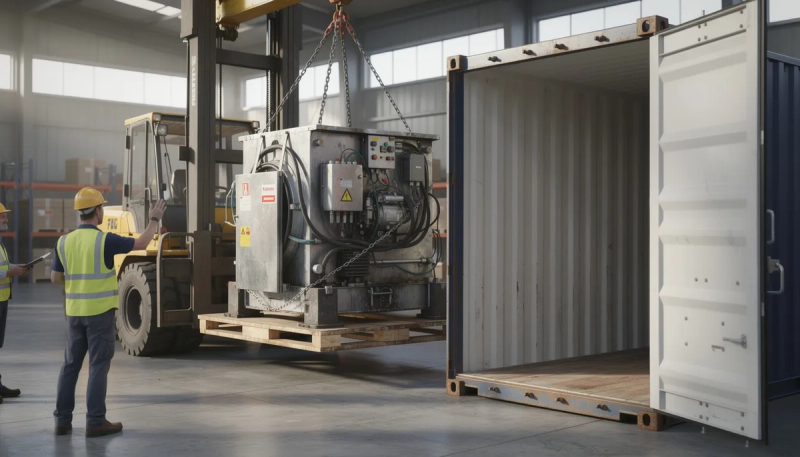
| Transport logistics | Container vs special transport |
| Dimensions and weight | Determines shipping cost |
Mechanical robustness is often valued more than cutting-edge software in certain export markets.
Structured sales process
Step 1: On-site inventory
Full mapping of woodworking machines, dust extraction systems, compressors, tooling and licences.
Step 2: Technical and commercial valuation
Assessment of brand, year, condition, usage and international demand
Step 3: Channel selection
Auction, targeted private sale or hybrid approach.
Step 4: Documentation preparation
Technical sheets, inspection reports and translations.
Step 5: Targeted marketing
Specialised woodworking channels and direct outreach.
Step 6: Completion
Dismantling coordination, logistics, export documentation and site clearance if required.
Dome Auctionsapplies this structured approach in projects involving fleet modernisation, relocation or closure between 2022–2026.
Conclusion
Selling woodworking machinery requires sector-specific expertise, structured documentation and access to the right buyer network. By combining technical knowledge with a strategic and digital approach, companies can optimise both value and timing.
For woodworking and joinery companies looking to modernise, scale or phase out operations, a sector-focused sales strategy provides clarity and stronger results.
FAQ on selling woodworking machinery
How long does a full sale process take?
Typically 6–16 weeks for 10–40 machines. Individual machines like panel saws or wide belt sanders may sell within 2–4 weeks.
Which machines are easiest to sell internationally in 2026?
- CNC nesting machines (2008+)
- PUR edge banders
- Modern panel saws with automation
- Profiling lines for windows and doors
- Reliable thickness planers and surface planers from A-brands
Should I refurbish machines before selling?
Full refurbishments rarely pay off. Targeted safety and technical checks are usually sufficient.
What about extraction systems and compressors?
They may be sold separately or bundled depending on project structure.
Can machines remain operational while for sale?
Often yes, provided clear agreements on inspection timing and dismantling dates.