
Introduction: Why selling construction equipment is a strategic decision
For companies active in construction, earthmoving and infrastructure, the decision to sell construction equipment has evolved beyond simple disposal. Today, releasing excavators, wheel loaders, telehandlers, access platforms and transport equipment is part of capital allocation and fleet strategy.
After record global sales of construction machinery in 2021–2022, driven by low financing costs and post-pandemic stimulus, the construction equipment market has shifted. Tighter financing conditions through 2023–2025 have prompted many European contractors to rebalance fleets and improve cash positions. This article examines how timing, demand cycles and structured processes influence resale value—supporting investments in new machines, including electric construction equipment.
CNIP, as a digital strategy partner, helps companies establish data-driven approaches to equipment disposal and marketing, ensuring consistent processes and measurable outcomes.
Understanding the market cycle before you sell
The heavy construction equipment market follows predictable cycles influenced by infrastructure spending, residential building activity and mining demand. Understanding where the market stands helps determine when to release assets.
- Global construction equipment sales peaked around 2021, exceeding 1.3 million units worldwide, supported by low interest rates and infrastructure stimulus programmes.
- European demand has remained substantial, representing approximately one-third of global heavy equipment revenue, with steady growth in Germany, France and the Benelux region through 2023–2025.
- Equipment demand typically tracks infrastructure investments with a 1–3 year lag, meaning announced projects signal future buyer activity.
- Q4 2024 European auction data showed median prices for crawler excavators declining approximately 21% compared to the previous year, indicating a normalising market after the 2021–2022 peak.
- Public infrastructure budgets—including EU cohesion funds, TEN-T network upgrades and national road programmes—provide signals for upcoming demand for used machines.
Selling when buyers are beginning new project cycles generally yields stronger prices than disposing during downturns.
Regional and sector demand: Where your used machines are really wanted
Demand for used equipment varies significantly across regions and sectors. Understanding these differences helps identify the right buyers.
- In Belgium and neighbouring countries, demand for excavators and wheel loaders is driven by road renewal, port expansions (Antwerp-Bruges, Rotterdam) and logistics infrastructure development.
- Central & Eastern Europe—Poland, Romania, Czech Republic, Hungary—continues absorbing 8–25 tonne excavators and mid-size loaders from Western Europe, supported by ongoing infrastructure catch-up and EU investments.
- North Africa and parts of the Middle East remain strong outlets for robust diesel earthmoving equipment and trucks, particularly when EU emission regulations reduce local demand for older Stage III/IV machines.
- Civil infrastructure and mining activities often command premiums for reliable 25–40 tonne excavators, while urban construction prioritises compact excavators, mini loaders and access platforms from 2016–2022 vintages.
- Broadening exposure beyond the home country through international platforms, auctions or brokers typically generates more competitive bidding than contacting only local dealers.
The construction industry across various industries and regions creates differentiated demand, offering sellers multiple pathways to market.
Timing the sale: When to release excavators, loaders and telehandlers
Seasonal patterns, project cycles and regulatory timelines all influence optimal selling windows. Practical timing rules include:
- In Northern Europe, demand for earthmoving equipment such as 14–30 tonne excavators and articulated dump trucks peaks from February to June, ahead of summer site activity.
- Access platforms and telehandlers may achieve better prices ahead of industrial shutdown seasons and logistics expansion projects, particularly Q3–Q4 warehouse buildouts expected in 2025 and 2026.
- Selling 6–12 months before planned fleet renewal or electrification programmes ensures capital availability for deposits on new machines and prevents market oversupply.
- Disposing of older diesel units before major regulatory steps—such as tighter emission zones anticipated in large European cities around 2027–2028—reduces risk of holding depreciating assets.
- Avoid releasing 15–20 machines simultaneously; instead, stagger disposal or use structured multi-lot auction events with defined closing dates to maintain competitive tension among buyers.
- Monitor leading indicators: order books, tender volumes and utilisation hours per machine guide decisions on which units to release first.
Timing sales around demand peaks rather than operational convenience typically improves outcomes.
The impact of electrification on resale value
The shift from diesel to electric machines is reshaping resale strategies across Europe, particularly for the period 2024–2030.
OEMs including Volvo Construction Equipment have launched electric compact excavators and wheel loaders. Many European cities—London, Oslo, Helsinki, Amsterdam—are implementing restrictions on diesel machinery in urban construction sites, with full bans or Stage compliance requirements expected by 2030.
As contractors in Belgium, the Netherlands and Scandinavia pilot electric fleets (mini excavators, compact loaders, scissor lifts), demand for high-quality used diesel units may soften in urban applications. However, rural markets, export destinations and regions without strict emission policies continue requiring these machines.
Companies should map which diesel units face the fastest value decline due to location-specific regulations—typically older 5–10L engine machines used in city projects—and prioritise selling these 2–3 years before new rules take effect.
Documenting telematics data, fuel efficiency and maintenance records reassures international buyers that older diesel machines remain reliable for export markets with several years of productive life remaining.
Fleet strategy: Deciding what to sell and what to keep
Strategic fleet decisions balance utilization, maintenance costs and project requirements. Key considerations include:
- Segment by role: Distinguish core production units (primary 30–40 tonne excavators), support units (skid steers, small wheel loaders) and low-utilisation assets (older access platforms, surplus trucks).
- Utilisation thresholds: Consider selling machines below 50% utilization for 12 consecutive months as part of an annual fleet review.
- Maintenance cost curves: When annual maintenance on a 7–10 year old loader or telehandler exceeds a defined percentage of estimated resale value, disposal becomes attractive.
- Project alignment: Retain machines matching secured contracts through 2027; release assets that do not fit upcoming project types (for example, surplus quarry machines when shifting to urban civil works).
- Engine capacity and power output considerations: Keep well-specified, high-utilisation machines from recent model years (2019–2024) where demand remains strong.
Fleet renewal should align capital release with investment requirements for new equipment, including electric machines entering the market.
Maximising resale value: Preparation, documentation and presentation
Equipment condition and documentation directly influence buyer confidence and final prices. Preparation steps include:
- Basic refurbishment: cleaning, minor bodywork, replacement of visibly worn items (tyres on wheel loaders, hoses on excavators, baskets on access platforms).
- Complete documentation: CE certificates, original invoices, service history, inspection reports, operating hours records and telematics logs.
- Standardised, high-quality photography and video: consistent angles, close-ups of undercarriage and pins on excavators, boom and chassis on telehandlers, cabin controls on all material handling equipment.
- Transparent defect descriptions: Building trust with professional buyers reduces renegotiation risk after inspection.
Quality presentation positions machines competitively and supports efficient sales processes.
Choosing a sales channel: Dealer, direct sale or structured auction
Different channels serve different objectives. Understanding trade-offs helps align approach with priorities.
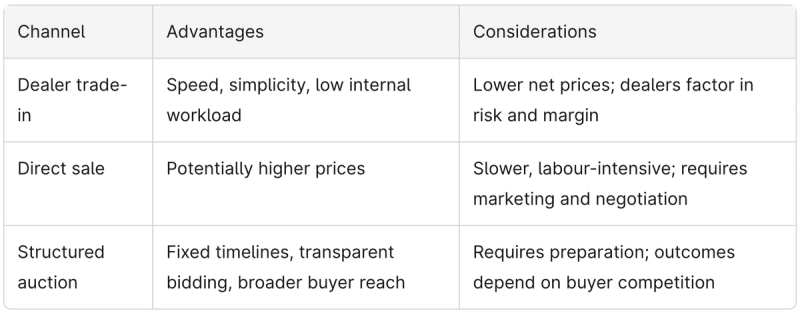
Structured online auctions—including those organised by platforms such as Dome Auctions in Belgium—work particularly well when selling multiple lots (10–20 excavators, loaders and trucks) within defined timeframes. Fixed closing dates concentrate buyer attention and enable price discovery across international buyers.
Align channel choice with objectives: balance sheet relief favours structured auctions; price maximisation for unique assets may warrant targeted direct sale.
Using data and digital marketing to reach the right buyers
Many European sellers underutilise existing data. Historical project contacts, rental partners and subcontractors can become segmented buyer lists for remarketing used machines.
Effective approaches include:
- Central database (CRM or automation tools such as HubSpot) with contacts tagged by sector, geography and equipment interest (for example, “earthmoving – CEE”, “access platforms – logistics Europe”).
- Targeted email campaigns, remarketing ads and LinkedIn outreach around specific sale events.
- Dashboards tracking enquiry volume, bid activity by region and final prices, generating insights for future fleet and timing decisions.
Digital marketing expands buyer reach from local to regional or international, improving competition and reducing time-to-cash.
Structuring the sales process for predictable outcomes
Ad-hoc selling often produces unpredictable prices and delays. A structured, time-bound process improves planning and cash flow visibility.
A recommended framework:
- Fleet review (3–6 months before sale): Identify candidates, assess condition
- Preparation: Inspections, photography, documentation completion
- Marketing phase: Campaigns running 3–4 weeks before closing
- Closing phase: Defined bidding window or negotiation period
Platforms like Dome Auctions provide structure through published catalogues, fixed inspection standards and concentrated bidding windows. Cross-functional alignment between operations, finance and marketing teams ensures consistent execution.
FAQ: Selling construction and heavy equipment
These questions address practical concerns for European construction, earthmoving and industrial companies selling used machines internationally.
How far in advance should I start planning the sale of my construction equipment?
For a single excavator or loader, 4–8 weeks may suffice. For structured disposal of 10–30 machines, planning should begin 3–6 months in advance. This allows time for inspections, preparation, marketing and channel selection. Longer lead times provide flexibility to align with seasonal demand peaks and reduce the risk of depreciating assets sitting idle.
What documentation do international buyers typically expect for used equipment?
Essential documentation includes registration documents, CE conformity certificates, proof of ownership, detailed service history, inspection reports, operating hours logs and export declaration documents. Manufacturer certifications add value. Missing paperwork reduces the buyer pool and can depress bids, particularly for cross-border sales within the EU and to regions with strict import controls.
Is it still worth selling older diesel equipment with high hours?
High-hour diesel machines (12,000+ hours on a wheel loader, for example) can attract buyers in markets with lower cost expectations or for secondary applications such as backup units in quarries. Pricing should be realistic, with transparency on condition, known repairs and remaining component life. Clear communication builds trust and reduces disputes.
How should smaller companies with only a few machines approach the sales process?
Smaller contractors should focus on thorough preparation and visibility. Ensure each machine has quality photography, clear descriptions and listings on platforms with relevant buyer traffic. Well-known online auctions or brokers provide market reach that individual sellers cannot easily achieve alone, making them effective for one-off assets.
Can digital marketing really make a difference when selling heavy equipment?
While pricing and condition remain primary drivers, digital marketing significantly increases the number and diversity of professional buyers viewing equipment within the selling window. Targeted campaigns, remarketing and CRM-based outreach transform equipment sales from local events into regional or international opportunities, typically improving price discovery and reducing time-to-cash.